Trezor–Host Protocol
This document specifies a secure protocol for encrypted and authenticated communication between a host application, such as Trezor Suite, and new Trezor models. This protocol replaces the unencrypted Codec v1 protocol used in earlier Trezor models (see protocol.md).
Intended audience
This document defines the format and internal workings of the communication protocol. It is intended for system integrators and security analysts. Those who wish to integrate Trezor in their application should use Trezor Connect or python-trezor, both of which implement this specification.
Table of contents
- Introduction
- Data transfer layer
- Transport layer
- Secure channel layer
- Other features
- References
Introduction
The purpose of this protocol is to establish a secure communication channel between a host application, such as Trezor Suite, and a Trezor device. When a given host establishes a secure channel with a Trezor for the first time, the two engage in a pairing procedure, which requires the user to complete one of the pairing methods listed in Section Pairing phase. After a successful pairing, the host may request that the Trezor issue a pairing credential. The credential allows reestablishment of the secure channel without user interaction in the future.
This protocol is designed to be compatible with various means of data transfer, such as USB or Bluetooth. It is split into the following layers:
- L1 Data transfer represents either USB or Bluetooth data transfer.
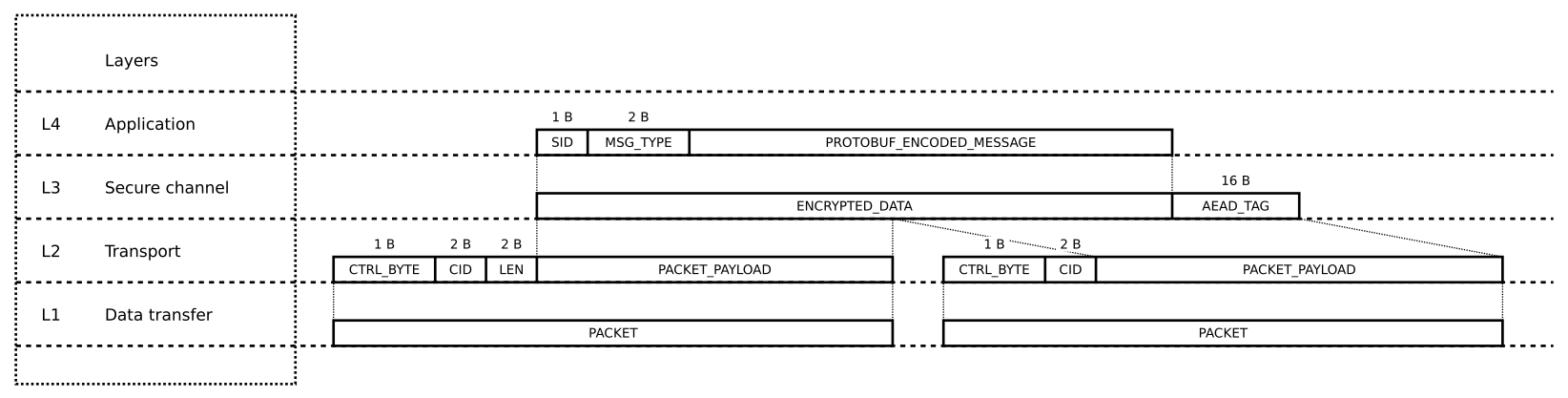
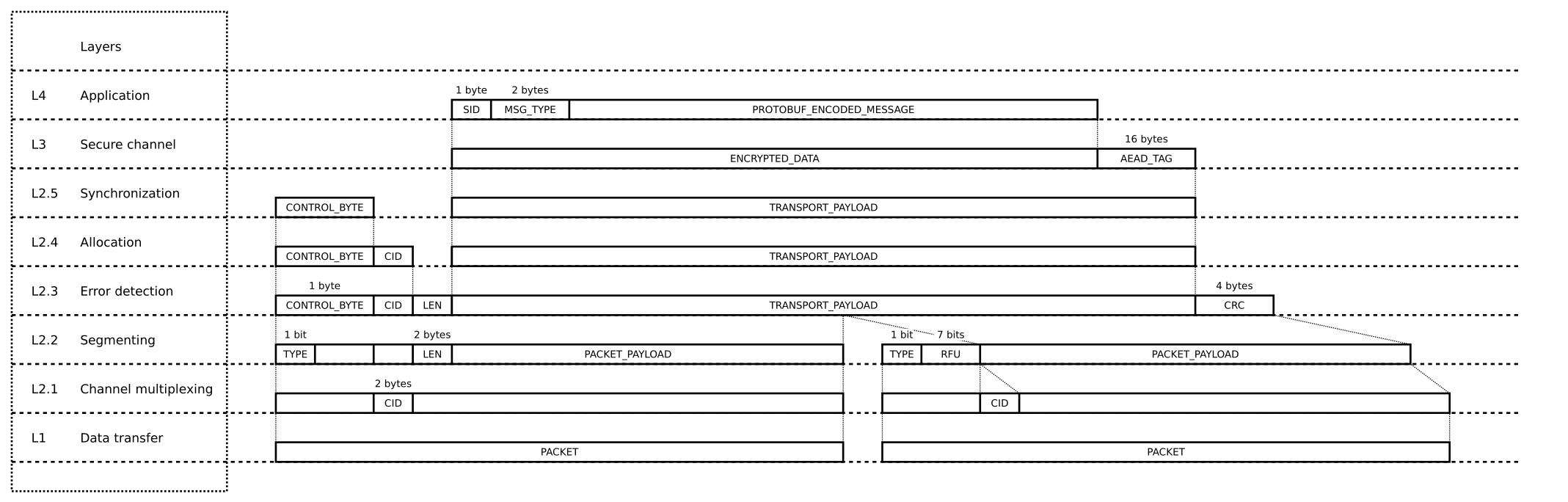
- L2 Transport is responsible for multiplexing transport connections onto the data transfer layer, segmenting of transport payloads, error detection and synchronization. It is divided into five sub-layers, which are described in the Transport layer section (Transport layer).
- L3 Secure channel is responsible for the encryption and the decryption of messages (see Secure channel layer).
- L4 Application handles sessions and the encoding of application messages in Protocol Buffers wire format. It is described in sessions.md
Connection process diagram
sequenceDiagram
  participant host
  participant Trezor
  rect rgb(35, 35, 35)
    Note right of host: Transport layer
    rect rgb(25,25,25)

        host ->> Trezor: ChannelAllocationRequest(nonce)
        Trezor ->> host: ChannelAllocationResponse(nonce, cid, device_properties)
    end
  end
    rect rgb(35, 35, 35)
        Note right of host: Secure channel layer
        rect rgb(25,25,25)
            host ->> Trezor: HandshakeInitiationRequest(host_ephemeral_pubkey)
            Trezor ->> host: HandshakeInitiationResponse(trezor_ephemeral_pubkey, encrypted_trezor_static_pubkey)
            host ->> Trezor: HandshakeCompletionRequest(encrypted_host_static_pubkey, encrypted_payload)
            Trezor ->> host: HandshakeCompletionResponse(encrypted_trezor_state)
            Note over host,Trezor: Pairing [conditional]
            Note over host,Trezor: Credential issuance [optional]
        host ->> Trezor: ThpEndRequest()
        Trezor ->> host: ThpEndResponse()
        end
    end
    Note over host,Trezor: Application layer - Encrypted transport
Data transfer layer
This protocol is designed to be compatible with various data transfer services, such as USB or Bluetooth, which transmit packets of a fixed maximum size. The data transfer service must preserve the order of packets transferred, but does not need to guarantee their delivery or integrity.
USB
All Trezor models support USB communication. To allow web applications to connect to Trezor, WebUSB is used for data transfer:
USB packet size
Trezor utilizes packets with a size of 64 bytes.
Bluetooth
Some Trezor models support Bluetooth. This section briefly describes the technology used and highlights important features.
Supported Bluetooth technology
The Bluetooth technology used is Bluetooth Low-Energy (BLE). The minimum supported version is 5.0. Trezor does not support BLE versions 4.x and below due to a lack of features and security concerns.
BLE Pairing methods
Trezor devices use Secure Simple Pairing with the Numeric Comparison association model. Legacy Pairing methods are not allowed or supported.
Privacy feature
Trezor devices use the LE Privacy feature by default. (LE Privacy)
Bluetooth LE supports a feature that reduces the ability to track a LE device over a period of time by changing the Bluetooth Device Address on a frequent basis.
— Bluetooth Core_v5.3 specification, section 5.4.5, page 275
BLE packet size
Trezor utilizes packets of 244 bytes in size.
Transport layer
The transport layer performs the segmentation of transport payloads into multiple packets that are transmitted over the data transfer layer. It is possible for several applications to communicate with Trezor using distinct transport connections, which are referred to as channels. The transport layer is responsible for the establishment and release of channels, multiplexing channels onto the data transfer layer, and channel synchronization.
Channel identifier
Channels are identified by a 16-bit channel identifier (CID). The CID 0xFFFF is reserved for the broadcast channel, which is used for channel allocation requests and responses. CIDs from 0xFFF0 to 0xFFFE, and 0x0000, are reserved for future use. Trezor allocates the remaining CIDs to individual host applications.
Transport packet structure
Each transport packet starts with a control byte that determines how the packet is processed by the receiver. Certain packet properties are identified using only a subset of the bits in the control byte; the remaining bits may take arbitrary values and MUST be ignored for the purpose of property identification. The recognized control byte patterns are listed in the table below. Bits denoted by X may have arbitrary values and are not considered when matching a packet to a property. For ease of implementation, each entry specifies a mask and the corresponding masked value. A control byte matches a given property if: control_byte & mask == masked_value. If a control byte does not match any pattern except initiation_packet (e.g. 00000111), it should be treated as an error (invalid control byte).
| Name | Control byte (binary) | Mask (&) | Masked value | Description | Handled by layer |
|---|---|---|---|---|---|
| initiation_packet | 0XXXXXXX | 0x80 | 0x00 | Identifies an initiation packet. | L 2.2 - Segmenting |
| continuation_packet | 1XXXXXXX | 0x80 | 0x80 | Identifies a continuation packet. | L 2.2 - Segmenting |
| channel_allocation_request | 01000000 | 0xFF | 0x40 | Request for a new channel identifier. | L 2.4 - Allocation |
| channel_allocation_response | 01000001 | 0xFF | 0x41 | Response with a new channel identifier. | L 2.4 - Allocation |
| transport_error | 01000010 | 0xFF | 0x42 | Transport layer errors (e.g. UNALLOCATED_CHANNEL). | L 2.4 - Allocation |
| ping | 01000011 | 0xFF | 0x43 | Transport level ping-pong messages | L 2 |
| pong | 01000100 | 0xFF | 0x44 | Transport level ping-pong messages | L 2 |
| codec_v1 | 00111111 | 0xFF | 0x3F | Codec v1 message legacy protocol. | L 2 |
| ack | 0010X000 | 0xF7 | 0x20 | Acknowledgement message. | L 2.5 - Synchronization |
| handshake_init_request | 000XX000 | 0xE7 | 0x00 | First message in the handshake process | L 3 - Handshake phase |
| handshake_init_response | 000XX001 | 0xE7 | 0x01 | Second message in the handshake process | L 3 - Handshake phase |
| handshake_completion_request | 000XX010 | 0xE7 | 0x02 | Third message in the handshake process | L 3 - Handshake phase |
| handshake_completion_response | 000XX011 | 0xE7 | 0x03 | Fourth message in the handshake process | L 3 - Handshake phase |
| encrypted_transport | 000XX100 | 0xE7 | 0x04 | Noise message, i.e. encrypted application message. | L 3 |
The transport layer distinguishes two basic types of transport packets: initiation packets and continuation packets. The highest bit of the control byte specifies whether the packet is an initiation packet or a continuation packet.
- type = 0 → initiation packet
- type = 1 → continuation packet
Let n be the packet size in bytes supported by the data transfer layer.
Initiation Packet
An initiation packet is the first packet to be sent when transmitting a transport payload. It has the following structure:
| Offset | Size | Field name | Description |
|---|---|---|---|
| 0 | 1 | control_byte | Control byte is used on multiple layers. For recognized values, see table Transport packet structure |
| 1 | 2 | cid | Channel identifier as a 16-bit integer in big-endian byte order. |
| 3 | 2 | length | Total size of the transport payload with CRC in bytes. Encoded as a 16-bit integer in big-endian byte order. |
| 5 | n−5 | packet_payload | First part of the transport payload with CRC. Padded with null bytes if no continuation packets follow. |
Continuation Packet
Continuation packets are sent after the initiation packet in cases where the transport payload does not fit in the initiation packet. Each continuation packet contains the following information:
| Offset | Size | Field name | Description |
|---|---|---|---|
| 0 | 1 | control_byte | The control byte set to 0x80. |
| 1 | 2 | cid | Channel identifier as a 16-bit integer in big-endian byte order. |
| 3 | n−3 | packet_payload | Continuation part of the transport payload with CRC. Padded with null bytes in the last continuation packet. |
The seven least significant bits of the control byte in a continuation packet are reserved for future use. The reserved bits should be set to zero when transmitting a continuation packet, and ignored when receiving a continuation packet.
Transport layer structure
The transport layer is further divided into five sub-layers.
Channel multiplexing layer
Multiplexing enables one data transfer connection to support more than one channel. This layer manages the identification of the channel for each packet transferred over the data transfer connection, in order to ensure that packet payloads from the various multiplexed channels are not mixed. The receiver groups the packets based on their channel identifier (CID) field. The channel multiplexing layer does not provide any packet filtering or error handling. (TODO add relevant part of session locking)
Segmenting layer
The segmenting layer is responsible for mapping one transport payload with CRC onto an initiation packet and zero or more continuation packets.
The sender segments the transport payload with CRC into one or more packet payloads, starting with an initiation packet, followed by the least possible number of continuation packets. The last packet payload is padded with null bytes.
The receiver reassembles the transport payload with CRC by concatenating the packet payloads, starting with an initiation packet and awaiting continuation packets on the same channel until the expected length of the transport payload with CRC has been received. Any padding in the last packed payload is discarded.
If a new initiation packet is received on a given channel before enough continuation packets have been received to reassemble the previous transport payload on that channel, then the receiver will discard the previous transport payload with CRC and begin reassembling the new transport payload with CRC.
If an initiation packet is received on a channel CID2 while reassembling the transport payload with CRC on a different channel CID1, then the receiver should reassemble both transport payloads with CRC in parallel independently for each channel.
If the receiver is not able to reassemble multiple payloads in parallel, then it should measure the time that elapsed since the last packet was received on channel CID1. If that time exceeds MIN_CONTINUATION_WAIT_MS, it should abort the reassembly of the transport payload with CRC on channel CID1, discard any previously reassembled data and begin reassembling the transport payload on channel CID2. If MIN_CONTINUATION_WAIT_MS is not exceeded, then it should notify the allocation layer to send a TRANSPORT_BUSY error on channel CID2.
If a continuation packet is received on a given channel when none is expected on that channel, then the receiver will discard the continuation packet.
Error detection layer
A cyclic redundancy check (CRC) error detection code is used to detect data corruption or the loss of continuation packets by the data transfer layer. The algorithm used to compute the CRC is CRC-32-IEEE, which utilizes the polynomial 0x04C11DB7 with its reversed form equal to 0xEDB88320. The CRC is computed over the header of the initiation packet and the transport payload as outlined in the table below. The result is encoded as 4 bytes in big-endian byte order and appended to the transport payload, which is referred to as transport payload with CRC.
The CRC is computed over the following data:
| Offset | Size | Field name | Description |
|---|---|---|---|
| 0 | 1 | control_byte | The control byte of the initiation packet. |
| 1 | 2 | cid | Channel identifier as a 16-bit integer in big-endian byte order. |
| 3 | 2 | length | Total size of the transport payload with CRC in bytes. Encoded as a 16-bit integer in big-endian byte order. |
| 5 | length – 4 | transport_payload | The transport payload. (Does not include CRC or padding.) |
The receiver validates the CRC. If invalid, then the transport payload is discarded.
Allocation layer
The allocation layer handles the establishment and release of channels and transport error handling. Host applications initiate communication with Trezor by requesting the establishment of a channel. The Trezor is responsible for the allocation of a unique channel identifier (CID) to each host application.
If Trezor receives a transport payload with a channel identifier that is not allocated, it will respond with an UNALLOCATED_CHANNEL error using the same channel identifier. Note: Implementation can respond to not allocated channel already after receiving an initiation packet (with unknown/unallocated CID).
A host application will ignore any data transmitted on a channel that has not been allocated to it.
Since Trezor maintains a channel allocation table of limited size, it may release a channel without warning, on a least-recently-used basis. The host application is not given any notification of channel release. The application will detect the release of the channel the next time it attempts to use the channel identifier, since it will receive an UNALLOCATED_CHANNEL error.
The host application requests the establishment of a new channel with Trezor by using the broadcast channel to send a ChannelAllocationRequest with a randomly generated 8-byte nonce. Trezor responds by using the broadcast channel to send a ChannelAllocationResponse consisting of a new channel identifier, the same nonce, and Trezor’s device properties. When the response is received, the host application compares the sent nonce with the received one. In case of a positive match, the application stores the received channel identifier and uses that for subsequent communication with Trezor. If the received nonce differs from the sent nonce, the host application ignores the response and keeps waiting for a ChannelAllocationResponse that has a matching nonce.
ChannelAllocationRequest uses the channel_allocation_request control byte and has the following transport payload:
| Offset | Size | Field name | Description |
|---|---|---|---|
| 0 | 8 | nonce | A random nonce to identify the Trezor’s response. |
ChannelAllocationResponse uses the channel_allocation_response control byte and has the following transport payload:
| Offset | Size | Field name | Description |
|---|---|---|---|
| 0 | 8 | nonce | The nonce from the ChannelAllocationRequest. |
| 8 | 2 | cid | A new channel identifier. |
| 10 | var | device_properties | Properties of the Trezor device containing a basic description of the device (model, device color) and capabilities (supported protocol version and pairing methods), see below. |
The device_properties field contains a serialized ThpDeviceProperties message. The message is encoded using the Protocol Buffers version 2 wire format and has the following definition:
message ThpDeviceProperties {
    required string internal_model = 1;               // Internal model name, e.g. "T2B1".
    optional uint32 model_variant = 2 [default = 0];  // Encodes the device properties such as color.
    required uint32 protocol_version_major = 3;       // The major version of the communication protocol used by the firmware.
    required uint32 protocol_version_minor = 4;       // The minor version of the communication protocol used by the firmware.
    repeated ThpPairingMethod pairing_methods = 5;    // Pairing methods supported by the Trezor.
}
The pairing methods are further described in the Pairing phase.
// Numeric identifiers of pairing methods.
enum ThpPairingMethod {
    SkipPairing = 1;  // Trust without MITM protection.
    CodeEntry = 2;    // User rewrites code displayed on Trezor into the host application.
    QrCode = 3;       // User scans QR-code displayed on Trezor into the host application.
    NFC = 4;          // Trezor and host application exchange authentication secrets via NFC.
}
The supported pairing methods are not implied by the model because some may be disabled by user settings or device mode. Trezor may also indicate a different set of pairing methods depending on the underlying means of data transfer, e.g., USB and Bluetooth.
Protocol-level errors are represented by messages identifed by the transport_error control byte. Such messages have the following transport payload:
| Offset | Size | Field name | Description |
|---|---|---|---|
| 0 | 1 | error_code | Transport error code encoded as a single byte. |
Recognized transport error codes are:
| Code | Name | Description |
|---|---|---|
| 0 | Reserved for future use. | |
| 1 | TRANSPORT_BUSY | Issued by the recipient when the transport layer is busy reassembling a message on another channel. |
| 2 | UNALLOCATED_CHANNEL | Issued by Trezor in response to a message that has a channel identifier which is not allocated. |
| 3 | DECRYPTION_FAILED | Issued by Trezor in response to a message that has an invalid authentication tag. For more information, see Secure channel layer. |
| 4 | Reserved for future use. | |
| 5 | DEVICE_LOCKED | Issued by Trezor in response to handshake messages (HandshakeInitiationRequest, HandshakeCompletionRequest) received while the device is locked. See Handshake phase. |
When the sender receives a TRANSPORT_BUSY error, it should notify the segmenting layer to cease transmitting packets and notify the synchronization layer to increase the timeout for the next retransmission of the transport payload by a random value in the range [0, MAX_BUSY_BACKOFF_MS].
When the host receives an UNALLOCATED_CHANNEL or DECRYPTION_FAILED error, it should consider the channel released, destroy any channel context, and establish a new channel with Trezor.
In addition, THP supports sending and receiving keep-alive messages (Ping and Pong) over a channel. Ping is sent with a random 8-byte nonce, to make sure the peer is available and responsive when Pong response is received (with the same nonce). Since it is a single packet message, no payload reassembly is required. This mechanism can be used by both sides (for example, the device can check that the channel is still responsive, and close it if needed).
Synchronization layer
The synchronization layer handles acknowledgement messages, which allow the receiver to inform the sender of the receipt of each transport payload. If acknowledgement is not received within a defined time, the sender infers the non-receipt of a transport payload and the need to re-transmit it. The sender may re-transmit the transport payload indefinitely. However, implementations can set a limit on the number of retransmissions (MAX_RETRANSMISSION_COUNT) to prevent power drainage or blocking of system resources. In particular, if the sender needs to transmit a transport payload on another channel and does not have the system resources to do so in parallel on both channels, then it should terminate retransmission on the unresponsive channel as long as at least MIN_RETRANSMISSION_COUNT retransmissions have been attempted. When retransmission is
- terminated without having received acknowledgement, the sender should release the unresponsive channel.
- interrupted (e.g. by losing BLE connection), the sender could continue the retransmission when the connection is (possibly) restored (or terminate the channel).
Sender should not assume a message to be received without a receipt of an acknowledgement message.
The primary function of the synchronization layer is to work as the Alternating Bit Protocol (ABP)[ABP69] ensuring reliable communication over an unreliable transport. As such, it handles sequence numbers, ACK messages, retransmissions, and timeouts. Secondly, it provides the higher layers (e.g., the Secure channel layer) with data payloads (and notifications).
It is possible that some packets are lost by the Data transfer layer (L1). In order to guarantee reliable communication, THP uses the Alternating Bit Protocol in combination with a CRC32 checksum.
Only the following message types take part in the synchronization layer: handshake_init_request, handshake_init_response, handshake_completion_request, handshake_completion_response, encrypted_transport and ACK. Notably channel_allocation_request, channel_allocation_response and transport_error don’t carry a sequence number and are not acknowledged.
Alternating Bit Protocol
The Alternating Bit Protocol (ABP) is a protocol between a sender and a receiver over an unreliable channel. The channel is unreliable in the sense that it can discard or duplicate messages, but it cannot change their order or content. The protocol guarantees the eventual and non-duplicative delivery of messages.
After sending a message, the sender doesn’t send any further messages until it receives an acknowledgement message (ACK). After receiving a valid message, the receiver sends an ACK. If the ACK does not reach the sender before a timeout, the sender re-transmits the message. THP uses a 1-bit sequence number that is part of the header of the initialization packet. This sequence number alternates (from 0 to 1) in subsequent messages. When the receiver sends an ACK, it includes the sequence number of the message it received.
The receiver can detect duplicated frames by checking if the message sequence numbers alternate. If two subsequent messages have the same sequence number, they are duplicates, and the second message is discarded. Similarly, if two subsequent ACKs reference the same sequence number, they are acknowledging the same message.
The situation is described by the following state machine.
ABP State machine
The sender alternates among states S0a, S0b, S1a, and S1b. The sender also keeps the state of a stopwatch. The sender starts in the state S0a.
The behavior of the sender in the state S0a is defined as follows:
- If there is a message that needs to be sent, take the following actions:
- Send the message with the sequence number equal to 0.
- Switch to state S0b.
- Reset and start the stopwatch.
- When the acknowledgment message is received and its sequence number equals 1, take the following actions:
- Consider the message to be a duplicate acknowledgment of the previously sent message.
- Transition to the state S0a.
- When the acknowledgment message is received and its sequence number equals 0, take the following actions:
- Consider the message to be an acknowledgment received out of order.
- Transition to the state S0a.
The behavior of the sender in the state S0b is defined as follows:
- When the acknowledgment message is received and its sequence number equals 0, take the following actions:
- Consider the previously sent message to be delivered.
- Transition to the state S1a.
- When the acknowledgment message is received and its sequence number equals 1, take the following actions:
- Consider the message to be a duplicate acknowledgment of the message sent before the previously sent one.
- Transition to the state S0b.
- When the stopwatch exceeds timeout, take the following actions:
- Consider the previously sent message or the corresponding acknowledgment to be lost.
- Resend the previously sent message, which is the last message with the sequence number equal to 0.
- Reset and start the stopwatch. (Note that the timeout does not need to be constant.)
- Transition to the state S0b.
The behavior of the sender in the state S1 is analogous. The full finite-state transducer of the sender is depicted in the following diagram:
flowchart LR
    S0a["S0a (send 0)"]
    S0b["S0b (wait Ack0)"]
    S1a["S1a (send 1)"]
    S1b["S1b (wait Ack1)"]

    S0a -- send Message(Seq=0) --> S0b
    S0b -- receive Ack(0) --> S1a
    S0b -- receive Ack(Seq=1) OR timeout+resend --> S0b

    S1a -- send Message(Seq=1) --> S1b
    S1b -- receive Ack(Seq=1) --> S0a
    S1b -- receive Ack(Seq=0) OR timeout+resend --> S1b

    S0a -- receive Ack(Seq=*) --> S0a
    S1a -- receive Ack(Seq=*) --> S1a
The receiver alternates between states R0 and R1. The receiver starts in the state R0.
The behavior of the receiver in the state R0 is defined as follows:
- When the message is received and its sequence number equals 0, take the following actions:
- Reply with an acknowledgement message with the sequence number equal to 0.
- Submit the received message to further processing.
- Transition to the state R1.
- When the message is received and its sequence number equals 1, take the following actions:
- Reply with an acknowledgement message with the sequence number equal to 1.
- Consider the message to be a duplicate of the previously received message (discard).
- Transition to the state R0.
The behavior of the receiver in the state R1 is analogous. The full finite-state transducer of the receiver is depicted in the following diagram:
flowchart LR
    R0["R0"]
    R1["R1"]

    R0 -- in: Message(Seq=0); out: Ack(Seq=0); return Message for processing --> R1
    R0 -- in: Message(Seq=1); out: Ack(Seq=1); discard Message as duplicate --> R0
    R1 -- in: Message(Seq=1); out: Ack(Seq=1); return Message for processing --> R0
    R1 -- in: Message(Seq=0); out: Ack(Seq=0); discard Message as duplicate --> R1
Encoding
The sequence bit is encoded into the control byte of the applicable messages, mask 0x10 (00010000).
The ACK bit can be similarly accessed using the mask 0x08 (00001000). On messages other than ACK, the ACK number is ignored unless piggybacking is enabled.
ACK Message structure
The ACK message has no payload except for the CRC. Its control_byte is set to ack with the appropriate sequence number, i.e. ACK_0 = 00100000 and ACK_1 = 00101000. The ACK message has the same sequence number as the message it acknowledges.
ACK piggybacking
ACK piggybacking is an optional feature. It allows to use a regular transport message to work as an ACK of the latest message received by using the ACK bit in the transport message control byte. ACK piggybacking significantly reduces the number of messages sent which is useful for longer flows - e.g. signing a transaction with a plethora of inputs/outputs.
Protocol parameters
| Parameter name | Default/suggested value | Description |
|---|---|---|
| MIN_RETRANSMISSION_COUNT | 2 | The minimum number of transport payload retransmissions that the sender should attempt, if under pressure to release system resources. |
| MAX_RETRANSMISSION_COUNT | 50 | The maximum number of transport payload retransmissions that the sender should attempt. |
| RETRANSMISSION_TIMEOUT_MS | variable | The interval between transport payload retransmissions in milliseconds. |
| MAX_BUSY_BACKOFF_MS | 500 | Maximum backoff time in milliseconds that the sender should add to the retransmission timeout when the receiver is busy receiving on another channel. |
| MIN_CONTINUATION_WAIT_MS | 200 | The minimum time in milliseconds that the receiver should wait for a continuation packet before terminating transport payload reassembly in favor of packets that are arriving on another channel. |
Secure channel layer
Connection process
The connection process involves the following steps:
- The parties establish communication over the data transfer layer.
- The host requests the allocation of a new communication channel by sending a
ChannelAllocationRequest, see Allocation layer. - The host initiates a secure channel handshake in order for the two parties to establish encrypted communication, see Handshake phase.
- If the host and the Trezor have not paired in the past, they mutually authenticate to protect against man-in-the-middle (MITM) attacks, see Pairing phase.
- After a successful pairing/connection, the host can ask Trezor for a long-time pairing credential. The credential allows the host to skip the pairing procedure when connecting from the same app and the same host device in the future, see Credential phase.
Trezor keeps a state machine of the channel. The possible states are the following:
- UNALLOCATED: Trezor does not recognize a channel with given
channel id. - Handshake states - TH1, TH2: Channel is in a handshake phase.
- Pairing states - TP0, TP1, TP2, TP3a, TP3b, TP3c: Channel is in a pairing phase.
- TC1: Channel is in a credential phase.
- ENCRYPTED_TRANSPORT: Channel is fully prepared for encrypted application communication.
Similarly, Host state machine has the following states: UNALLOCATED, HH0, HH1, HH2, HH3, HP0, HP1, HP2, HP3a, HP3b, HP4, HP5, HP6, HP7, HC0, HC1, ENCRYPTED_TRANSPORT. The meaning of the UNALLOCATED and ENCRYPTED_TRANSPORT states is the same for both the Trezor and the host. Detailed information about the handshake, pairing, and credential phase states is provided in their respective sections.
The Trezor and the host each have a static X25519 key pair that they use to mutually authenticate one another when establishing a secure communication channel, see Common definitions. The Trezor’s static key pair is denoted by $(S_{T,priv}, S_{T,pub})$ and the host’s static key pair is denoted $(S_{H,priv}, S_{H,pub})$. The process for establishing the secure channel is referred to as a handshake. This process results in a pair of AES encryption keys $k_{req}$ and $k_{resp}$, which are used to encrypt request messages sent by the host to the Trezor and responses from Trezor to the host. During the handshake, the parties determine whether they have paired in the past. If not, then a pairing phase follows the handshake. After these phases have been successfully completed, the parties enter the application traffic phase.
If either party encounters any error in the secure channel communication, such as unexpected messages, invalid message format, failure to decrypt data, or verify a MAC, it should terminate the handshake process and transition the channel to UNALLOCATED state.
Handshake phase
The handshake is based on the XX handshake pattern as specified by the Noise Protocol Framework. Trezor’s static key pair is not used directly in the handshake. A masked public key is used instead. It is derived as shown below from the Trezor’s ephemeral public key, which is generated during the handshake.
trezor_masked_static_pubkey = X25519(SHA-256(trezor_static_pubkey || trezor_ephemeral_pubkey), trezor_static_pubkey).
Messages
The following messages are handled by the secure channel layer. The receiver of the messages HandshakeInitiationRequest, HandshakeInitiationResponse, HandshakeCompletionRequest and HandshakeCompletionResponse must assert that their control byte corresponds to the expected message given by the state machine.
| Message | Control byte | Sender |
|---|---|---|
| HandshakeInitiationRequest | handshake_init_request | host |
| HandshakeInitiationResponse | handshake_init_response | Trezor |
| HandshakeCompletionRequest | handshake_completion_request | host |
| HandshakeCompletionResponse | handshake_completion_response | Trezor |
sequenceDiagram
  participant host
  participant Trezor

  host ->> Trezor: HandshakeInitiationRequest(host_ephemeral_pubkey)
  Trezor ->> host: HandshakeInitiationResponse(trezor_ephemeral_pubkey, encrypted_trezor_static_pubkey)
  host ->> Trezor: HandshakeCompletionRequest(encrypted_host_static_pubkey, encrypted_payload)
  Trezor ->> host: HandshakeCompletionResponse(encrypted_trezor_state)
Handshake initiation request (HandshakeInitiationRequest)
The message is sent from the host to the Trezor.
| Offset | Size | Field name | Description |
|---|---|---|---|
| 0 | 32 | host_ephemeral_pubkey | host’s ephemeral public key |
| 32 | 1 | try_to_unlock | do not raise error on locked device, show pin_entry screen, used with 0x01 mask |
Handshake initiation response (HandshakeInitiationResponse)
The message is sent from the Trezor to the host.
| Offset | Size | Field name | Description |
|---|---|---|---|
| 0 | 32 | trezor_ephemeral_pubkey | Trezor’s ephemeral public key |
| 32 | 48 | encrypted_trezor_static_pubkey | encrypted and authenticated Trezor’s masked static public key |
| 80 | 16 | tag | encrypted and authenticated empty string |
Handshake completion request (HandshakeCompletionRequest)
The message is sent from the host to the Trezor.
| Offset | Size | Field name | Description |
|---|---|---|---|
| 0 | 48 | encrypted_host_static_pubkey | encrypted and authenticated host’s static public key |
| 48 | var | encrypted_payload | encrypted authenticated message payload |
Before the payload is encrypted, it is encoded using the Protocol Buffers version 2 wire format as a message with the following definition:
message ThpHandshakeCompletionReqNoisePayload {
    optional bytes host_pairing_credential = 1;  // Host's pairing credential
}
Handshake completion response (HandshakeCompletionResponse)
The message is sent from the Trezor to the host. It is sent as an encrypted payload.
| Offset | Size | Field name | Description |
|---|---|---|---|
| 0 | 17 | encrypted_trezor_state | encrypted and authenticated Trezor’s state |
Common definitions
The X25519 function, Curve25519, and key pair generation are specified in RFC 7748.
Let protocol_name = Noise_XX_25519_AESGCM_SHA256\\x00\\x00\\x00\\x00.
Let HKDF(ck, input) be the function defined as follows:
- Let temp_key = HMAC-SHA-256(ck, input).
- Let output_1 = HMAC-SHA-256(temp_key, byte(0x01)).
- Let output_2 = HMAC-SHA-256(temp_key, output_1 || byte(0x02)).
- Return (output_1, output_2).
Notation
-
0^n— a string ofnzero bits. Example:0^96represents a 96-bit string of all zeros. -
0^n || 1— concatenation ofnzero bits with a single bit1. Example:0^95 || 1represents 95 zero bits followed by a 1 bit (total 96 bits). -
||— concatenation of byte strings. -
empty_string— a zero-length byte string. -
SHA-256(input)— the SHA-256 hash of the input byte string. -
X25519(privkey, pubkey)— X25519 scalar multiplication usingprivkeyandpubkey. -
AES-GCM-ENCRYPT(key, IV, ad, plaintext)— AES encryption in Galois/Counter Mode. -
AES-GCM(key, IV, ad, plaintext)— AES-GCM operation returning the authentication tag. -
ELLIGATOR2(input)— maps an input to a Curve25519 public key using the Elligator 2 encoding. -
HKDF(ck, input)— HMAC-based key derivation function producing a new chaining key and session key, see Common definitions. -
PROTOBUF-DECODE(type, data)— deserializes the byte stringdatainto a Protocol Buffers message of the specifiedtype. -
ValidateCredential(cred_auth_key, credential, host_static_public_key)— returnsTrueifcredentialis valid for the givencred_auth_keyandhost_static_public_key; otherwise returnsFalse.
Trezor’s state machine
Let device_properties be the properties advertised by the Trezor in ChannelAllocationResponse.
Let (trezor_static_privkey, trezor_static_pubkey) be a X25519 key pair that persists Trezor restarts.
Let cred_auth_key be a symmetric 16-byte key that persists Trezor’s restarts.
flowchart TD TH1 -- in: HandshakeInitiationRequest<br>out: HandshakeInitiationResponse --> TH2 TH2 -- in: HandshakeCompletionRequest [paired]<br>out: HandshakeCompletionResponse --> TC1 TH2 -- in: HandshakeCompletionRequest [unpaired]<br>out: HandshakeCompletionResponse --> TP1
State TH1
The behavior of the Trezor in the state TH1(device_properties, trezor_static_privkey, trezor_static_pubkey) is defined as follows:
When the message HandshakeInitiationRequest(host_ephemeral_pubkey, try_to_unlock) is received, take the following actions:
- Generate a new ephemeral X25519 key pair (trezor_ephemeral_privkey, trezor_ephemeral_pubkey).
- Set h = SHA-256(protocol_name || device_properties).
- Set h = SHA-256(h || host_ephemeral_pubkey).
- Set h = SHA-256(h || try_to_unlock).
- Set h = SHA-256(h || trezor_ephemeral_pubkey).
- Set ck, k = HKDF(protocol_name, X25519(trezor_ephemeral_privkey, host_ephemeral_pubkey)).
- Set mask = SHA-256(trezor_static_pubkey || trezor_ephemeral_pubkey).
- Set trezor_masked_static_pubkey = X25519(mask, trezor_static_pubkey).
- Set encrypted_trezor_static_pubkey = AES-GCM-ENCRYPT(key=k, IV=0^96, ad=h, plaintext=trezor_masked_static_pubkey).
- Set h = SHA-256(h || encrypted_trezor_static_pubkey).
- Set ck, k = HKDF(ck, X25519(mask, X25519(trezor_static_privkey, host_ephemeral_pubkey))).
- Set tag = AES-GCM(key=k, IV=0^96, ad=h, plaintext=empty_string).
- Set h = SHA-256(h || tag).
- Send the message HandshakeInitiationResponse(trezor_ephemeral_pubkey, encrypted_trezor_static_pubkey, tag) to the host.
- Transition to the state TH2(h, k, ck, trezor_ephemeral_privkey).
State TH2
The behavior of the Trezor in the state TH2(h, k, ck, trezor_ephemeral_privkey) is defined as follows:
When the message HandshakeCompletionRequest(encrypted_host_static_pubkey, encrypted_payload) is received, take the following actions:
- Set host_static_pubkey, success = AES-GCM-DECRYPT(key=k, IV=0^95 || 1, ad=h, ciphertext=encrypted_host_static_pubkey). Assert that success is True.
- Set h = SHA-256(h || encrypted_host_static_pubkey).
- Set ck, k = HKDF(ck, X25519(trezor_ephemeral_privkey, host_static_pubkey)).
- Set payload_binary, success = AES-GCM-DECRYPT(key=k, IV=0^96, ad=h, ciphertext=encrypted_payload). Assert that success is True.
- Set h = SHA-256(h || encrypted_payload).
- Set payload = PROTOBUF-DECODE(type=ThpHandshakeCompletionReqNoisePayload, data=payload_binary).
- If ValidateCredential(cred_auth_key, payload.host_pairing_credential, host_static_pubkey) == True, then:
- Set credential = PROTOBUF-DECODE(type=ThpPairingCredential, data=payload.host_pairing_credential).
- Set host_name = credential.cred_metadata.host_name.
- Set app_name = credential.cred_metadata.app_name.
- Set trezor_state = STATE_PAIRED (or STATE_PAIRED_AUTOCONNECT - see Channel replacement). Otherwise, set trezor_state = STATE_UNPAIRED.
- Set key_request, key_response = HKDF(ck, empty_string).
- Set encrypted_trezor_state = AES-GCM-ENCRYPT(key=key_response, IV=0^96, ad=empty_string, plaintext=trezor_state).
- Send the message HandshakeCompletionResponse(encrypted_trezor_state) to the host.
- Set nonce_request = 0 and nonce_response = 1.
- Set encryption_state = (key_request, key_response, nonce_request, nonce_response).
- If trezor_state == STATE_PAIRED, transition to the state TC1(host_static_pubkey, host_name, app_name). If trezor_state == STATE_UNPAIRED, transition to the state TP1.
Host’s state machine
Let (host_static_privkey, host_static_pubkey) be a X25519 key pair that persists host restarts.
Let credentials be a list of pairs consisting of Trezor’s static public key and the corresponding credential.
Let device_properties be the Trezor’s properties advertised by the Trezor in ChannelAllocationResponse.
Let pairing_methods be the pairing methods supported by the Trezor (retrieved from the device_properties).
flowchart TD
HH0 -- out: HandshakeInitiationRequest --> HH1
HH1 -- [Trezor is known]<br>in: HandshakeInitiationResponse<br>out: HandshakeCompletionRequest --> HH2
HH1 -- [Trezor is unknown]<br>in: HandshakeInitiationResponse<br>out: HandshakeCompletionRequest --> HH3
HH3 -- in: HandshakeCompletionResponse [trezor is not paired] ---> HP0
HH2 -- in: HandshakeCompletionResponse [trezor is paired] ---> HC0
HH2 -- in: HandshakeCompletionResponse [trezor is not paired] ---> HP0
State HH0
The behavior of the host in the state HH0(try_to_unlock) is defined as follows:
Take the following actions:
- Generate a new ephemeral X25519 key pair (host_ephemeral_privkey, host_ephemeral_pubkey).
- Send the message HandshakeInitiationRequest(host_ephemeral_pubkey, try_to_unlock) to the Trezor.
- Transition to the state HH1(host_ephemeral_privkey, host_ephemeral_pubkey, try_to_unlock).
State HH1
The behavior of the host in the state HH1(host_ephemeral_privkey, host_ephemeral_pubkey, try_to_unlock) is defined as follows:
When the message HandshakeInitiationResponse(trezor_ephemeral_pubkey, encrypted_trezor_static_pubkey, tag) is received, take the following actions:
- Set h = SHA-256(protocol_name || device_properties).
- Set h = SHA-256(h || host_ephemeral_pubkey).
- Set h = SHA-256(h || try_to_unlock).
- Set h = SHA-256(h || trezor_ephemeral_pubkey).
- Set ck, k = HKDF(protocol_name, X25519(host_ephemeral_privkey, trezor_ephemeral_pubkey)).
- Set trezor_masked_static_pubkey, success = AES-GCM-DECRYPT(key=k, IV=0^96, ad=h, ciphertext=encrypted_trezor_static_pubkey). Assert that success is True.
- Set h = SHA-256(h || encrypted_trezor_static_pubkey).
- Set ck, k = HKDF(ck, X25519(host_ephemeral_privkey, trezor_masked_static_pubkey)).
- Set payload_of_tag, success = AES-GCM-DECRYPT(key=k, IV=0^96, ad=h, ciphertext=tag). Assert that success is True and payload_of_tag == empty_string.
- Set h = SHA-256(h || tag).
- Search credentials for pairs (trezor_static_pubkey, credential) such that trezor_masked_static_pubkey == X25519(SHA-256(trezor_static_pubkey || trezor_ephemeral_pubkey), trezor_static_pubkey).
- If found, then do the following:
- Find a tuple (host_static_privkey, host_static_pubkey) associated with the trezor_static_pubkey
- Set state = STATE_PAIRED.
- Set host_pairing_credential = credential.
- If not found, then do the following:
- Generate a new tuple (host_static_privkey, host_static_pubkey).
- Set state = STATE_UNPAIRED.
- Set host_pairing_credential = None (the optional field host_pairing_credential in the protobuf message is omitted).
- If found, then do the following:
- Set encrypted_host_static_pubkey = AES-GCM-ENCRYPT(key=k, IV=0^95 || 1, ad=h, plaintext=host_static_pubkey).
- Set h = SHA-256(h || encrypted_host_static_pubkey).
- Set ck, k = HKDF(ck, X25519(host_static_privkey, trezor_ephemeral_pubkey)).
- Set payload_binary = PROTOBUF-ENCODE(type=ThpHandshakeCompletionReqNoisePayload, host_pairing_credential).
- Set encrypted_payload = AES-GCM-ENCRYPT(key=k, IV=0^96, ad=h, plaintext=payload_binary).
- Set h = SHA-256(h || encrypted_payload).
- Send the message HandshakeCompletionRequest(encrypted_host_static_pubkey, encrypted_payload) to the Trezor.
- If state == STATE_PAIRED, then transition to the state HH2(ck). Otherwise, transition to the state HH3(pairing_methods, ck).
State HH2
The behavior of the host in the state HH2(ck) is defined as follows:
When the message HandshakeCompletionResponse(encrypted_trezor_state) is received, take the following actions:
- Set key_request, key_response = HKDF(ck, empty_string).
- Set trezor_state, success = AES-GCM-DECRYPT(key=key_response, IV=0^96, ad=empty_string, ciphertext=encrypted_trezor_state). Assert that success is True.
- Set nonce_request = 0 and nonce_response = 1.
- Set encryption_state = (key_request, key_response, nonce_request, nonce_response).
- If trezor_state == STATE_PAIRED (or STATE_PAIRED_AUTOCONNECT - see Channel replacement), then transition to the state HC0. Otherwise, transition to the state HP0(pairing_methods).
State HH3
The behavior of the host in the state HH3(pairing_methods, ck) is defined as follows:
When the message HandshakeCompletionResponse(encrypted_trezor_state) is received, take the following actions:
- Set key_request, key_response = HKDF(ck, empty_string).
- Set trezor_state, success = AES-GCM-DECRYPT(key=key_response, IV=0^96, ad=empty_string, ciphertext=encrypted_trezor_state). Assert that success is True.
- Assert that trezor_state == STATE_UNPAIRED.
- Set nonce_request = 0 and nonce_response = 1.
- Set encryption_state = (key_request, key_response, nonce_request, nonce_response).
- Transition to the state HP0(pairing_methods).
Pairing phase
Pairing phase protects against potential MITM attacks. Currently, three pairing methods are designed:
- Code Entry - the user must re-write a code displayed on the Trezor to the host device.
- NFC - the host and the Trezor have a short communication using NFC, the host must be in proximity of the Trezor.
- QrCode - the user must scan a QR-Code from the Trezor’s display.
As of 2026/04/07, only CodeEntry pairing method is fully supported by Trezor devices. (See GitHub issue: Add support for more THP pairing methods)
Messages
The following messages are handled by the application layer.
message ThpPairingRequest {
    required string host_name = 1;  // Human-readable host name (browser name for web apps)
    required string app_name = 2;   // Human-readable application name
}

message ThpPairingRequestApproved {}

message ThpSelectMethod {
    required ThpPairingMethod selected_pairing_method = 1;  // Pairing method selected by the host
}

message ThpPairingPreparationsFinished {}

message ThpCodeEntryCommitment {
    required bytes commitment = 1;  // SHA-256 of Trezor's random 32-byte secret
}

message ThpCodeEntryChallenge {
    required bytes challenge = 1;  // Host's random 32-byte challenge
}

message ThpCodeEntryCpaceTrezor {
    required bytes cpace_trezor_public_key = 1;  // Trezor's ephemeral CPace public key
}

message ThpCodeEntryCpaceHostTag {
    required bytes cpace_host_public_key = 1;  // Host's ephemeral CPace public key
    required bytes tag = 2;                    // SHA-256 of shared secret
}

message ThpCodeEntrySecret {
    required bytes secret = 1;  // Trezor's secret
}

message ThpQrCodeTag {
    required bytes tag = 1;  // SHA-256 of shared secret
}

message ThpQrCodeSecret {
    required bytes secret = 1;  // Trezor's secret
}

message ThpNfcTagHost {
    required bytes tag = 1;  // Host's tag
}

message ThpNfcTagTrezor {
    required bytes tag = 1;  // Trezor's tag
}
Trezor’s state machine
flowchart TD
selected_method[selected method]
style selected_method stroke-dasharray: 2 ,2
subgraph "TP3" [" "]
TP3a
TP3b
TP3c
end
TP0 -- "in: ThpPairingRequest<br>out: ThpPairingRequestApproved" --> TP1
TP1 -- "in: ThpSelectMethod" --> selected_method
TP2 -- "in: ThpCodeEntryChallenge<br>out: ThpCodeEntryCpaceTrezor" --> TP3a
selected_method -- "[selected_method == CodeEntry and it WAS NOT selected before]<br>out: ThpCodeEntryCommitment" --> TP2
selected_method -- "[selected_method == CodeEntry and it WAS selected before]<br>out: ThpPairingPreparationsFinished" --> TP3a
selected_method -- "[selected_method == QrCode]<br>out: ThpPairingPreparationsFinished" --> TP3b
selected_method -- "[selected_method == Nfc]<br>out: ThpPairingPreparationsFinished" --> TP3c
TP3 -- "in: ThpSelectMethod" --> selected_method
TP3a -- "in: ThpCodeEntryCpaceHostTag <br>out: ThpCodeEntrySecret" --> TC1
TP3b -- "in: ThpQrCodeTag<br>out: ThpQrCodeSecret" --> TC1
TP3c -- "in: ThpNfcTagHost<br>out: ThpNfcTagTrezor" --> TC1
State TP0
The behavior of Trezor in the state TP0 is defined as follows:
When the message ThpPairingRequest(host_name, app_name) is received, take the following action:
- Display a dialog “Allow {app_name} on {host_name} to pair with this Trezor?” on the screen.
- Send ButtonRequest message.
- Wait for ButtonAck Response from the host.
- Wait for user interaction:
- The user cancelled the dialog - end pairing, send ActionCancelled Failure, drop the channel
- The user confirmed the dialog - transition to state TP1
State TP1
The behavior of Trezor in the state TP1 is defined as follows:
- When the message ThpSelectMethod(selected_pairing_method) is received, transition to the intermediate state “selected method”.
State “selected method”
- Read selected_pairing_method from the received message ThpSelectMethod(selected_pairing_method).
- Check that selected_pairing_method is allowed and supported by the Trezor. If it is not allowed, raise an exception.
- selected_pairing_method is ThpPairingMethod_CodeEntry and it WAS NOT selected before
- Generate a random 16-byte code_entry_secret.
- Set commitment = SHA-256(code_entry_secret).
- Send the message ThpCodeEntryCommitment(commitment) to the host.
- Transition to the state TP2.
- selected_pairing_method is ThpPairingMethod_CodeEntry and it WAS selected before
- Display code_code_entry on the Trezor’s screen. (Note that code_code_entry is created only once per pairing - see State TP2).
- Send the message ThpPairingPreparationsFinished() to the host.
- Transition to the state TP3a.
- selected_pairing_method is ThpPairingMethod_QrCode
- Generate a random 16-byte qr_code_secret.
- Set code_qr_code = SHA-256(ThpPairingMethod_QrCode || handshake_hash || qr_code_secret)[:16].
- Display QR Code on the Trezor’s screen.
- Send the message ThpPairingPreparationsFinished() to the host.
- Transition to the state TP3b.
- selected_pairing_method is ThpPairingMethod_NFC
- Generate a random 16-byte nfc_secret_trezor.
- Display “NFC Dialog” on the Trezor’s screen.
- Enable NFC (read-mode).
- Send the message ThpPairingPreparationsFinished() to the host.
- Transition to the state TP3c.
State TP2
The behavior of Trezor in the state TP2 is defined as follows:
- When the message ThpCodeEntryChallenge(challenge) is received, take the following actions:
- Set code_code_entry_hash = SHA-256(ThpPairingMethod_CodeEntry || handshake_hash || code_entry_secret || challenge).
- Interpret code_code_entry_hash as an unsigned big-endian integer and set code_code_entry = code_code_entry_hash % 1000000.
- Display code_code_entry on the screen.
- Compute pregenerator as the first 32 bytes of SHA-512(prefix || code_code_entry || padding || handshake_hash || 0x00), where prefix is the byte-string 0x08 || 0x43 || 0x50 || 0x61 || 0x63 || 0x65 || 0x32 || 0x35 || 0x35 || 0x06, code_code_entry is encoded as an ASCII representation of the 6-digit code (with prepended zeroes if needed -
f"{code_code_entry:06}".encode("ascii")), and padding is the byte-string 0x6f || 0x00 ^ 111 || 0x20. - Set generator = ELLIGATOR2(pregenerator).
- Generate a random 32-byte cpace_trezor_private_key.
- Set cpace_trezor_public_key = X25519(cpace_trezor_private_key, generator).
- Send the message ThpCodeEntryCpaceTrezor(cpace_trezor_public_key) to the host.
- Transition to the state TP3a.
State TP3a
- When the message ThpSelectMethod(selected_pairing_method) is received, transition to the intermediate state “selected method”.
- When the message ThpCodeEntryCpaceHostTag(cpace_host_public_key, tag) is received, take the following actions:
- Clear the screen.
- Assert that cpace_host_public_key != 0x00 ^ 32.
- Set shared_secret = X25519(cpace_trezor_private_key, cpace_host_public_key).
- Assert that shared_secret != 0x00 ^ 32. This prevents the host from using low-order points to bypass code entry authentication.
- Assert that tag == SHA-256(shared_secret).
- Send the message ThpCodeEntrySecret(code_entry_secret) to the host.
- Transition to the state TC1.
State TP3b
- When the message ThpSelectMethod(selected_pairing_method) is received, transition to the intermediate state “selected method”.
- When the message ThpQrCodeTag(tag) is received, take the following actions:
- Clear the screen.
- Assert that tag == SHA-256(handshake_hash || code_qr_code).
- Send the message ThpQrCodeSecret(qr_code_secret) to the host.
- Transition to the state TC1.
State TP3c
- When the message ThpSelectMethod(selected_pairing_method) is received, transition to the intermediate state “selected method”.
- When data is received over NFC, take the following action:
- Parse the received data as nfc_secret_host || handshake_hash_digest_H.
- Set handshake_hash_digest_T as the first 16 bytes of handshake_hash.
- Assert that handshake_hash_digest_H == handshake_hash_digest_T.
- Send nfc_secret_trezor || handshake_hash_digest_T over the NFC.
- When the message ThpSelectMethod(selected_pairing_method) is received, transition to the intermediate state “selected method”.
- When the message ThpNfcTagHost(tag_host) is received, take the following actions:
- Clear the screen.
- Assert that tag_host == SHA-256(ThpPairingMethod_NFC || handshake_hash || nfc_secret_trezor).
- Set tag_trezor = SHA-256(ThpPairingMethod_NFC || handshake_hash || nfc_secret_host).
- Send the message ThpNfcTagTrezor(tag_trezor) to the host.
- Transition to the state TC1.
Host’s state machine
flowchart TD HP0 -- "out: ThpPairingRequest" --> HP1 HP1 -- in: ThpPairingRequestApproved<br>out: ThpSelectMethod[CodeEntry] --> HP2 HP1 -- in: ThpPairingRequestApproved<br>out: ThpSelectMethod[Nfc or QrCode] --> HP3b HP2 -- in: ThpCodeEntryCommitment<br>out: ThpCodeEntryChallenge --> HP3a HP3a -- in: ThpCodeEntryCpaceTrezor --> HP4 HP3b -- in: ThpPairingPreparationsFinished --> HP4 HP4 -- in: [user wants to change pairing method]<br>[selected method is CodeEntry and it was selected for the first time]<br> out: Select Method[CodeEntry] --> HP2 HP4 -- in: [user wants to change pairing method]<br>[Nfc or QrCode or CodeEntry (not first time)]<br> out: Select Method --> HP3b HP4 -- in: [user enters code]<br>out: ThpCodeEntryCpaceHostTag--> HP5 HP5 -- in: ThpCodeEntrySecret --> HC0 HP4 -- in: [user scans qr code]<br>out: ThpQrCodeTag --> HP6 HP6 -- in: ThpQrCodeSecret --> HC0 HP4 -- in: [user uses NFC]<br>out: ThpNfcTagHost --> HP7 HP7 -- in: ThpNfcTagTrezor --> HC0
State HP0
The behavior of the host in the state HP0 is defined as follows:
- Take the following actions:
- Send the message ThpPairingRequest(host_name, app_name) to the Trezor.
- Transition to the state HP1
State HP1
The behavior of the host in the state HP1 is defined as follows:
- When the message ThpPairingRequestApproved is received, take the following actions:
- Set selected_pairing_method to one of the pairing method supported by Trezor from the device_properties received during handshake. The selection can be done by the user or by using pre-defined default settings.
- Send the message ThpSelectMethod(selected_pairing_method) to the Trezor.
- When the selected_pairing_method is CodeEntry, take the following action:
- Transition to the state HP2.
- When the selected_pairing_method is NOT CodeEntry, take the following action:
- Transition to the state HP3b.
State HP2
The behavior of the host in the state HP2 is defined as follows:
- When the message ThpCodeEntryCommitment(commitment) is received, take the following actions:
- Generate a random 16-byte challenge.
- Send the message ThpCodeEntryChallenge(challenge) to the Trezor.
- Transition to the state HP3a.
State HP3a
The behavior of the host in the state HP3a is defined as follows:
- When the message ThpCodeEntryCpaceTrezor(cpace_trezor_public_key) is received, take the following actions:
- Transition to the state HP4.
State HP3b
The behavior of the host in the state HP3b is defined as follows:
- When the message ThpPairingPreparationsFinished() is received, take the following actions:
- Transition to the state HP4.
State HP4
- When changing the pairing method to CodeEntry and CodeEntry is selected for the first time in this pairing process, take the following actions:
- Set selected_pairing_method to ThpPairingMethod_CodeEntry
- Send the message ThpSelectMethod(selected_pairing_method) to the Trezor.
- Transition to the state HP2.
- When changing the pairing method to CodeEntry and CodeEntry is selected for the second time (or more) in this pairing process, take the following actions:
- Set selected_pairing_method to ThpPairingMethod_CodeEntry
- Send the message ThpSelectMethod(selected_pairing_method) to the Trezor.
- Transition to the state HP3b.
- When changing the pairing method to Nfc or QrCode, take the following actions:
- Set selected_pairing_method to one of (ThpPairingMethod_NFC, ThpPairingMethod_QrCode).
- Send the message ThpSelectMethod(selected_pairing_method) to the Trezor.
- Transition to the state HP3b.
- When the selected_pairing_method is CodeEntry and user enters code, take the following action:
- Disable all code entry methods.
- Compute pregenerator as the first 32 bytes of SHA-512(prefix || code || padding || handshake_hash || 0x00), where prefix is the byte-string 0x08 || 0x43 || 0x50 || 0x61 || 0x63 || 0x65 || 0x32 || 0x35 || 0x35 || 0x06, code is encoded using ASCII, and padding is the byte-string 0x6f || 0x00 ^ 111 || 0x20.
- Set generator = ELLIGATOR2(pregenerator).
- Generate a random 32-byte cpace_host_private_key.
- Set cpace_host_public_key = X25519(cpace_host_private_key, generator).
- Set shared_secret = X25519(cpace_host_private_key, cpace_trezor_public_key).
- Set tag = SHA-256(shared_secret).
- Send the message ThpCodeEntryCpaceHostTag(cpace_host_public_key, tag) to the Trezor.
- Transition to the state HP5.
- When the selected_pairing_method is QrCode and host scans the code from Trezor’s display, take the following action:
- Set code as the data scanned from the Qr Code.
- Set tag = SHA-256(handshake_hash || code).
- Send the message ThpQrCodeTag(tag).
- Transition to the state HP6.
- When the selected_pairing_method is Nfc and user brings the device close (nfc communication is possible), take the following action:
- Generate a random 16-byte secret_H.
- Set handshake_hash_digest_H as the first 16 bytes of handshake_hash.
- Send secret_H || handshake_hash_digest_H over the NFC.
- Read secret_T || handshake_hash_digest_T from the NFC.
- Assert that handshake_hash_digest_H == handshake_hash_digest_T.
- Set tag_H = SHA-256(ThpPairingMethod_NFC || handshake_hash_H || secret_T).
- Send the message ThpNfcTagHost(tag_H).
- Transition to the state HP7.
State HP5
The behavior of the host in the state HP5 is defined as follows:
- When the message ThpCodeEntrySecret(secret) is received, take the following actions:
- Assert that commitment = SHA-256(secret).
- Assert that code = SHA-256(ThpPairingMethod_CodeEntry || handshake_hash_H || secret || challenge) % 1 000 000 (BigEndian).
- Transition to the state HC0.
State HP6
The behavior of the host in the state HP6 is defined as follows:
- When the message ThpQrCodeSecret(secret) is received, take the following actions:
- Assert that code = SHA-256(ThpPairingMethod_QrCode || handshake_hash_H || secret)[:16].
- Transition to the state HC0.
State HP7
The behavior of the host in the state HP7 is defined as follows:
- When the message ThpNfcTagTrezor(tag_T) is received, take the following actions:
- Assert that tag_T = SHA-256(ThpPairingMethod_NFC || handshake_hash_H || secret_H).
- Transition to the state HC0.
Notes
The purpose of prefix and padding is to be compatible with the suite CPACE-X25519-SHA512 in the symmetric setting as it was in draft-irtf-cfrg-cpace-10 where
- the associated data fields (ADa and ADb) are empty strings,
- the session identifier (sid) and the channel identifier (CI) are empty strings
- the password-related string (PRS) is the code that the user rewrites from Trezor to the host and
- pairing_secret is the resulting intermediate session key (ISK).
NFC pairing sequence
sequenceDiagram
  participant host
  participant Trezor
  host ->> Trezor: ThpSelectMethod[Nfc]
  note over Trezor: secret_T = random_bytes(16)
  Trezor ->> host: ThpPairingPreparationsFinished
  note over host: secret_H = random_bytes(16)
  host -->> Trezor: secret_H, handshake_hash_H[:16] (over NFC)
  note over Trezor: assert handshake_hash_H[:16] == handshake_hash_T[:16]
  Trezor -->> host: secret_T, handshake_hash_T[:16] (over NFC)
  note over host: assert handshake_hash_T[:16] == handshake_hash_H[:16]
  note over host: tag_H = sha256(ThpPairingMethod_NFC || handshake_hash_H || secret_T)
  host ->> Trezor: tag_H
  note over Trezor: assert tag_H == sha256(ThpPairingMethod_NFC || handshake_hash_T || secret_T)
  note over Trezor: tag_T = sha256(ThpPairingMethod_NFC || handshake_hash_T || secret_H)
  Trezor ->> host: tag_T
  note over host: assert tag_T == sha256(ThpPairingMethod_NFC || handshake_hash_H || secret_H)
QR Code pairing sequence
sequenceDiagram
  participant host
  participant Trezor

  host ->> Trezor: ThpSelectMethod[QrCode]
  note over Trezor: secret = random_bytes(16)
  note over Trezor: code = sha256(ThpPairingMethod_QrCode || handshake_hash_T || secret)[:16]
  Trezor ->> host: ThpPairingPreparationsFinished
  Trezor -->> host: code (QR Code)
  note over host: tag = sha256(handshake_hash_H || code)
  host ->> Trezor: tag
  note over Trezor: assert tag == sha256(handshake_hash_T || code)
  Trezor->> host: secret
  note over host: assert code == sha256(ThpPairingMethod_QrCode || handshake_hash_H || secret)[:16]
Code Entry pairing sequence
Separated diagrams
sequenceDiagram
  participant host - first time
  participant Trezor

  host - first time ->> Trezor: ThpSelectMethod[CodeEntry]
  note over Trezor: secret = random_bytes(16)
  note over Trezor: commitment = sha256(secret)
  Trezor ->> host - first time: commitment
  note over host - first time: challenge = random_bytes(16)
  host - first time ->> Trezor: challenge
  note over Trezor: code = sha256(ThpPairingMethod_CodeEntry || handshake_hash_T || secret || challenge) % 1 000 000 (BigEndian)
  note over Trezor: pregenerator = sha512(prefix || code || padding || handshake_hash_T || 0x00)[:32]<br>generator = ELLIGATOR2(pregenerator)<br>cpace_trezor_private_key = random_bytes(32)<br>cpace_trezor_public_key = X25519(cpace_trezor_private_key, generator)
  Trezor ->> host - first time: cpace_trezor_public_key
  Trezor -->> host - first time: code (user rewrites code from Trezor to host)
  note over host - first time: pregenerator = sha512(prefix || code || padding || handshake_hash_H || 0x00)[:32]<br>generator = ELLIGATOR2(pregenerator)<br>cpace_host_private_key = random_bytes(32)<br>cpace_host_public_key = X25519(cpace_host_private_key, generator)<br>shared_secret = X25519(cpace_host_private_key, cpace_trezor_public_key)<br>tag=sha256(shared_secret)
  host - first time ->> Trezor: cpace_host_public_key, tag
  note over Trezor: assert cpace_host_public_key != 0x00 ^ 32<br>shared_secret = X25519(cpace_trezor_private_key, cpace_host_public_key)<br>assert shared_secret != 0x00 ^ 32
  note over Trezor: assert tag == sha256(shared_secret)
  Trezor ->> host - first time: secret
  note over host - first time: assert commitment == sha256(secret)
  note over host - first time: assert code == SHA-256(ThpPairingMethod_CodeEntry || handshake_hash_H || secret || challenge) % 1 000 000 (BigEndian)
sequenceDiagram
  participant host - second (or more) time
  participant Trezor

  host - second (or more) time ->> Trezor: ThpSelectMethod[CodeEntry]

  Trezor ->> host - second (or more) time : ThpPairingPreparationsFinished
  Trezor -->> host - second (or more) time : code (user rewrites code from Trezor to host)
  note over host - second (or more) time : pregenerator = sha512(prefix || code || padding || handshake_hash_H || 0x00)[:32]<br>generator = ELLIGATOR2(pregenerator)<br>cpace_host_private_key = random_bytes(32)<br>cpace_host_public_key = X25519(cpace_host_private_key, generator)<br>shared_secret = X25519(cpace_host_private_key, cpace_trezor_public_key)<br>tag=sha256(shared_secret)
  host - second (or more) time  ->> Trezor: cpace_host_public_key, tag
  note over Trezor: assert cpace_host_public_key != 0x00 ^ 32<br>shared_secret = X25519(cpace_trezor_private_key, cpace_host_public_key)<br>assert shared_secret != 0x00 ^ 32
  note over Trezor: assert tag == sha256(shared_secret)
  Trezor ->> host - second (or more) time : secret
  note over host - second (or more) time : assert commitment == sha256(secret)
  note over host - second (or more) time : assert code == SHA-256(ThpPairingMethod_CodeEntry || handshake_hash_H || secret || challenge) % 1 000 000 (BigEndian)
Combined diagram
sequenceDiagram
  participant host
  participant Trezor
  participant host - first time
  participant host - second or more time

  host - first time ->> Trezor: ThpSelectMethod[CodeEntry]
  note over Trezor: secret = random_bytes(16)
  note over Trezor: commitment = sha256(secret)
  Trezor ->> host - first time: commitment
  note over host - first time: challenge = random_bytes(16)
  host - first time ->> Trezor: challenge
  note over Trezor: code = sha256(ThpPairingMethod_CodeEntry || handshake_hash_T || secret || challenge) % 1 000 000 (BigEndian)
  note over Trezor: pregenerator = sha512(prefix || code || padding || handshake_hash_T || 0x00)[:32]<br>generator = ELLIGATOR2(pregenerator)<br>cpace_trezor_private_key = random_bytes(32)<br>cpace_trezor_public_key = X25519(cpace_trezor_private_key, generator)
  Trezor ->> host - first time: cpace_trezor_public_key
  host - second or more time ->> Trezor: ThpSelectMethod[CodeEntry]
  Trezor ->> host - second or more time: ThpPairingPreparationsFinished
  Trezor -->> host: code (user rewrites code from Trezor to host)
  note over host: pregenerator = sha512(prefix || code || padding || handshake_hash_H || 0x00)[:32]<br>generator = ELLIGATOR2(pregenerator)<br>cpace_host_private_key = random_bytes(32)<br>cpace_host_public_key = X25519(cpace_host_private_key, generator)<br>shared_secret = X25519(cpace_host_private_key, cpace_trezor_public_key)<br>tag=sha256(shared_secret)
  host ->> Trezor: cpace_host_public_key, tag
  note over Trezor: assert cpace_host_public_key != 0x00 ^ 32<br>shared_secret = X25519(cpace_trezor_private_key, cpace_host_public_key)<br>assert shared_secret != 0x00 ^ 32
  note over Trezor: assert tag == sha256(shared_secret)
  Trezor ->> host: secret
  note over host: assert commitment == sha256(secret)
  note over host: assert code == SHA-256(ThpPairingMethod_CodeEntry || handshake_hash_H || secret || challenge) % 1 000 000 (BigEndian)
Credential phase
In credential phase, the host can request a long-term pairing credential (THP credential) from Trezor. THP credential can be used by the host next time in the handshake phase - to avoid the need to go through the pairing procedure. Even when the host is connecting with a credential, a confirmation of connection by user is required (by default). However, when the host has a valid credential available, they can ask Trezor for an autoconnect credential. When a valid autoconnect credential is used during the handshake phase, no connection confirmation is required from the user .
Messages
The following messages are handled by the application layer.
message ThpCredentialRequest {
    required bytes host_static_public_key = 1;        // Host's static public key identifying the credential.
    optional bool autoconnect = 2 [default = false];  // Whether host wants to autoconnect without user confirmation
    optional bytes credential = 3;                    // Host's previous credential
}

message ThpCredentialResponse {
    required bytes trezor_static_public_key = 1;  // Trezor's static public key used in the handshake.
    required bytes credential = 2;                // The pairing credential issued by the Trezor to the host.
}

message ThpEndRequest {}

message ThpEndResponse {}
The following messages are used internally by Trezor - should not be transported over-the-wire or used in the host’s implementation. The host should treat the pairing credential as opaque bytes.
message ThpCredentialMetadata {
    option (internal_only) = true;
    required string host_name = 1;  // Human-readable host name (browser name for web apps)
    optional bool autoconnect = 2;  // Whether host is allowed to autoconnect without user confirmation
    required string app_name = 3;   // Human-readable application name
}

message ThpPairingCredential {
    option (internal_only) = true;
    required ThpCredentialMetadata cred_metadata = 1;  // Credential metadata
    required bytes mac = 2;                            // Message authentication code generated by the Trezor
}

message ThpAuthenticatedCredentialData {
    option (internal_only) = true;
    required bytes host_static_public_key = 1;         // Host's static public key used in the handshake
    required ThpCredentialMetadata cred_metadata = 2;  // Credential metadata
}
Credential authentication key
For credential issuance and validation, a credential authentication key (cred_auth_key) is used. This key is derived from two components - device secret and a counter (cred_auth_key_counter). The device secret is independent of seed and is generated randomly first time it is needed. The cred_auth_key_counter is 4 bytes big-endian initiated to zero.
Credential validation
Let ValidateCredential(cred_auth_key, credential_binary, host_static_pubkey) be the function defined as follows:
- Set credential = PROTOBUF-DECODE(type=ThpPairingCredential, credential_binary).
- Set authenticated_credential_data = PROTOBUF-ENCODE(type=ThpAuthenticatedCredentialData, host_static_pubkey, credential.cred_metadata).
- Set mac = HMAC-SHA-256(cred_auth_key, authenticated_credential_data).
- Return mac == credential.mac.
Credential invalidation
Incrementing the cred_auth_key_counter results in a new cred_auth_key, invalidating all previously issued THP credentials. The design does not allow to invalidate a single selected credential - only all credentials can be invalidated, or none.
Credential issuance
Let IssueCredential(cred_auth_key, host_static_pubkey, credential_metadata) be the function defined as follows:
- Set authenticated_credential_data = PROTOBUF-ENCODE(type=ThpAuthenticatedCredentialData, host_static_pubkey, credential_metadata).
- Set mac = HMAC-SHA-256(cred_auth_key, authenticated_credential_data).
- Set credential_raw = PROTOBUF-ENCODE(type=ThpPairingCredential, credential_metadata, mac).
- Return credential_raw.
Autoconnect credential issuance
The host can request an autoconnect credential by sending the ThpCredentialRequest message to the Trezor - it is even possible to do when the communication is in the encrypted transport phase. The request must contain an already issued (valid) credential. Trezor does not allow host to request an autoconnect credential without the host providing a valid credential.
Trezor’s state machine
graph TD
    TC1 -- in: ThpCredentialRequest<br>out: ThpCredentialResponse --> TC1
    TC1 -- in: ThpEndRequest<br>out: ThpEndResponse --> TS["transport state"]
State TC1
The behavior of Trezor in the state TC1(host_static_pubkey, host_name, app_name) is defined as follows:
- When the message ThpEndRequest() is received, take the following actions:
- Transition to the transport state.
- When the message ThpCredentialRequest(host_static_pubkey) is received, take the following actions:
- Set credential_metadata = ThpCredentialMetadata(host_name, app_name).
- Set credential = IssueCredential(cred_auth_key, host_static_pubkey, credential_metadata).
- Send the message ThpCredentialResponse(trezor_static_pubkey, credential) to the host.
- Transition to the state TC1.
Host’s state machine
flowchart TD
  HC0 -- out: ThpEndRequest --> HC2
  HC0 -- out: ThpCredentialRequest --> HC1
  HC1 -- in: ThpCredentialResponse<br>out: ThpCredentialRequest --> HC1
  HC1 -- in: ThpCredentialResponse<br>out: ThpEndRequest --> HC2
  HC2 -- in: ThpEndResponse --> TS["transport state"]
State HC0
The behavior of the host in the state HC0 is defined as follows:
-
Take the following actions:
- Send ThpCredentialRequest(host_static_pubkey) to the Trezor. Transition to the state HC1.
OR
- Exit the Credential phase by sending ThpEndRequest() to Trezor. Transition to state HC2.
State HC1
The behavior of the host in the state HC1 is defined as follows:
-
When the message ThpCredentialResponse(trezor_static_pubkey, credential) is received, take the following actions:
- Append (trezor_static_pubkey, credential) to credentials. If the host uses multiple static key-pairs, associate the tuple (host_static_privkey, host_static_pubkey) generated for this connection with the trezor_static_pubkey.
Then take one of the following actions:
- Send the message ThpEndRequest() to the Trezor and transition to the state HC2.
OR
- Send another message ThpCredentialRequest(host_static_pubkey) to the Trezor. Keep the state HC1.
State HC2
The behavior of the host in the state HC2 is defined as follows:
- When the message ThpEndResponse() is received, take the following actions:
- Transition to the transport state.
Notes
The host_static_pubkey used in the credential can be different from the one used in the handshake. This is a deliberate choice, as it gives more flexibility to the host.
Example usage: the host uses a randomly generated key to pair with an unknown device, but the static keys used for credentials (known devices) are chosen, e.g., a single key used for all known Trezors, or keys derived from a key hierarchy.
Other features
Channel replacement
A new trezor_state STATE_PAIRED_AUTOCONNECT was introduced. The name is a bit misleading, as it is not used for autoconnect credentials, yet. It is generally the same as STATE_PAIRED with an additional guarantee that there will not be a user confirmation required. It is currently used only when a channel is being replaced.
When a new channel is created and an old channel with the same host static public key is still in the Trezor’s cache, all sessions from the old channel are migrated to the new one and the provided credential is treated as if it were autoconnect even if it is not.
It is not used for autoconnect credentials yet, as the host knows whether it used an autoconnect credential and thus whether to expect user confirmation. In the case of channel replacement, the host cannot be sure that the old channel is still in Trezor’s cache.
Possible trezor_state values:
- STATE_UNPAIRED - Pairing is required. If a credential was used during handshake, it did not pass Trezor’s validation (the credential failed verification).
- STATE_PAIRED - Pairing is skipped. User confirmation of the connection might be required - it is determined by the autoconnect field of the credential used.
- STATE_PAIRED_AUTOCONNECT - Pairing is skipped. User confirmation of the connection will not be required.
Channel replacement helps to reduce the number of user confirmations in cases where the host is already trusted and the connection was interrupted (the old channel must be valid - in the ENCRYPTED_TRANSPORT state). Also, as the sessions from the old channel are migrated to the new one - it allows users to not enter passphrases repeatedly in case of such interruption.
Example usecase - the host application crashes/restarts.
Note: STATE_PAIRED_AUTOCONNECT can be viewed as a special case of STATE_PAIRED.
References
[ABP69] K. A. Bartlett, R. A. Scantlebury, and P. T. Wilkinson, “A note on reliable full-duplex transmission over half-duplex links,” Communications of the ACM, vol. 12, no. 5, pp. 260–261, May 1969. https://dl.acm.org/doi/pdf/10.1145/362946.362970